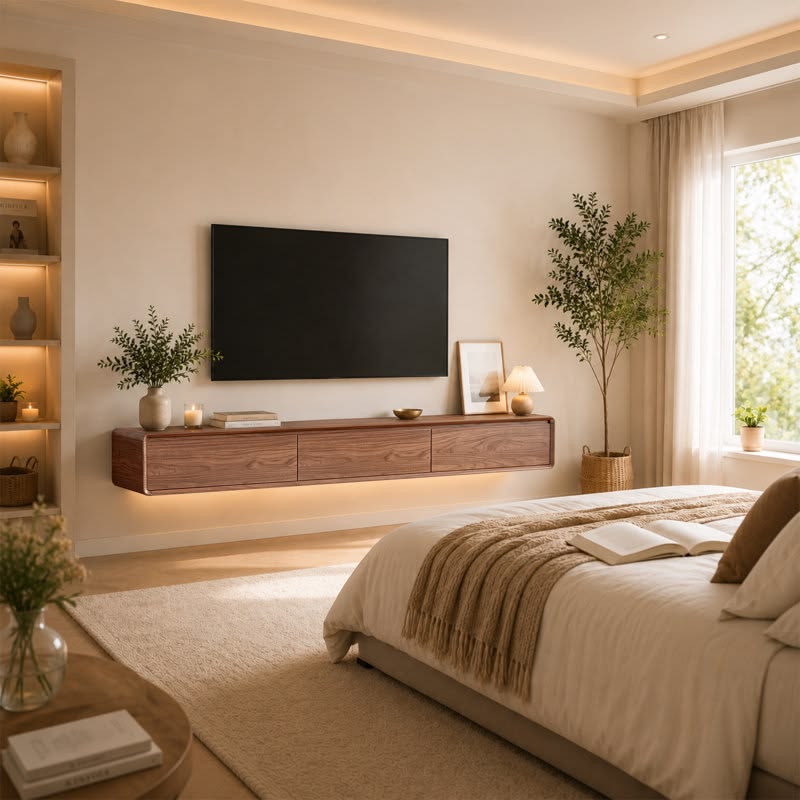
These 17 Bedroom Art Above Bed ideas will help you choose artwork that fits your room, feels balanced, and stays safely placed above the headboard.
The best art above a bed is scaled to the wall, secured properly, and matched to the bedroom’s colors and style. Choose one large piece, a balanced pair, a gallery arrangement, or a lightweight textile, leaving enough space above the headboard.
I’ll cover sizes, materials, colors, layouts, and easy styling tricks so your bedroom feels finished instead of crowded.
A Quick Primer on Bedroom Art Above the Bed
The wall above your bed is usually the bedroom’s main focal point. It is also a tricky spot because the art needs to look good from across the room while staying secure near where you sleep. I like to treat this wall as a quiet backdrop, not a place to display every favorite item at once. Large art can make a small room feel more complete, while several smaller pieces add personality and movement. The best choice depends on your headboard, ceiling height, wall width, color palette, and decorating style. Before buying anything, measure the wall and decide whether you want the artwork to feel calm, bold, cozy, natural, or collected.
1. Hang One Oversized Landscape Print

A single oversized landscape print creates a calm, finished look with very little effort. Try a misty mountain scene, a soft beach view, a field of wildflowers, or an abstract image that suggests open space. Choose a frame width that is about two-thirds to three-quarters of the bed width. For a queen bed, artwork around 40 to 60 inches wide often looks balanced, depending on the room.
Keep the colors gentle if you want the bedroom to feel restful. Blue-gray, sand, olive, cream, and warm brown all work well. Use a slim black frame for a modern room or a light wood frame for a rustic or Scandinavian space.
Install the artwork 6 to 10 inches above the headboard. This layout works in modern, traditional, farmhouse, and coastal homes. Once you have the main scale right, you can explore a softer two-piece arrangement.
2. Pair Two Prints With a Shared Theme

Two matching or related prints add balance without making the wall feel stiff. I often suggest botanical drawings, black-and-white photographs, simple line art, or two abstract pieces that share one color. Hang them side by side with a 3 to 6 inch gap between frames.
The pair should work as one visual group. Their combined width should be close to the width of the headboard, though a little narrower is usually safer than too wide. Use identical frames for a polished look. If you prefer a relaxed room, choose different frames in the same finish, such as natural wood and pale oak.
Place the center of the pair at eye level when standing, while keeping the lower edge about 6 to 10 inches above the headboard. This idea suits traditional, transitional, coastal, and contemporary rooms. Next, let’s make the artwork feel more personal with a small collection.
3. Build a Three-Panel Art Arrangement

A three-panel arrangement can bring rhythm to a wide bedroom wall. The panels might form one continuous image, such as a beach photograph or leafy mural, or they can show three separate images with matching colors. This setup works especially well above a wide upholstered headboard.
Look for panels with simple visual lines. Busy images can become distracting when divided into sections. Keep the spacing even, usually around 2 to 4 inches between panels. The outside edges should stay inside the headboard’s visual width. If the headboard is 78 inches wide, a three-panel arrangement around 60 to 72 inches wide may feel proportionate.
Choose a narrow frame so the installation does not look heavy. This style adapts easily to modern, tropical, art deco, and coastal bedrooms. After a structured arrangement, a looser gallery wall offers more room for personality.
4. Create a Small Gallery Wall With a Clear Shape

A gallery wall above the bed can display family photos, travel images, sketches, or collected artwork. The key is giving the arrangement a clear outer shape. A rectangle works best over a rectangular headboard. A wider horizontal layout usually feels more natural than a tall one.
Start by placing the pieces on the floor. Leave 2 to 4 inches between frames and take a photo before hanging anything. Include one larger anchor piece, two medium pieces, and a few smaller accents. Repeat one frame color or one visual theme so the collection feels connected.
Avoid placing tiny frames too high or spreading the group across the entire wall. Keep the bottom edge roughly 6 to 8 inches above the headboard. This works in eclectic, traditional, maximalist, and cottage spaces. For a quick reference, use the size guide below.
Bedroom Art Size Guide
| Bed size | Suggested single artwork width | Suggested gallery width | Ideal art height above headboard |
|---|---|---|---|
| Twin | 24 to 36 inches | 20 to 32 inches | 6 to 10 inches |
| Full | 30 to 42 inches | 28 to 38 inches | 6 to 10 inches |
| Queen | 40 to 60 inches | 36 to 54 inches | 6 to 10 inches |
| King | 50 to 72 inches | 48 to 66 inches | 6 to 10 inches |
| California king | 50 to 72 inches | 48 to 66 inches | 6 to 10 inches |
Now that the overall layouts are covered, let’s look at natural materials that make the wall feel warmer.
5. Add a Woven Wall Hanging for Soft Texture

A woven wall hanging brings softness to a bedroom that has many hard surfaces. Look for macramé, woven wool, rattan, jute, or a flat textile with a simple pattern. These materials add texture without the visual weight of a thick framed picture.
Choose a piece that is slightly narrower than the headboard. Cream, oatmeal, tan, rust, and dusty rose work well with neutral bedding. If the room already has a lot of texture, select a flat weave instead of a heavily fringed design.
Use a strong wall hook rated for the item’s weight. Check that the dowel or rod is secure and that no loose cords hang near lamps or fans. A woven piece fits boho, desert, rustic, coastal, and Scandinavian bedrooms. From texture, we can move into a classic art choice that brings nature indoors.
6. Frame Botanical Prints in Natural Wood

Botanical art is an easy way to add nature without turning the bedroom into a garden theme. Ferns, olive branches, pressed leaves, palms, and simple herb drawings all work well. You can use one large print or arrange four small prints in a tidy grid.
Natural wood frames support a relaxed look, while white frames feel fresh and light. For a darker bedroom, walnut or stained oak adds contrast. Keep the paper background white, cream, or pale gray so the images remain easy to see.
Try matching the artwork to a plant, throw pillow, or curtain color already in the room. A small green detail repeated twice is usually enough. This idea suits farmhouse, cottage, modern organic, and traditional spaces. If your room needs stronger contrast, black-and-white photography is the next smart option.
7. Use Black-and-White Photography for Gentle Contrast

Black-and-white photography gives a bedroom a clean, grown-up feel. Consider architectural photos, quiet landscapes, close-up textures, or candid family images. Because the palette is limited, the style can blend with many bedding colors.
A large photo above the bed looks bold, while a pair of smaller photographs feels more balanced. Choose matte paper or a low-glare finish, especially if the wall faces a window. Thin black frames look modern. Warm wood frames soften the contrast and work well in rustic or mid-century rooms.
Keep the surrounding bedding simple if the photo has strong shadows or dramatic lines. Hang the piece where direct sunlight will not fade it quickly. This look adapts to modern, industrial, minimalist, and classic bedrooms. Next, we can add color without relying on a busy picture.
8. Choose an Abstract Piece That Repeats Bedroom Colors

Abstract art can connect the whole bedroom when it repeats colors from the bedding, rug, curtains, or accent chair. Look for loose brushstrokes, soft shapes, arches, blocks, or layered neutrals. You do not need to understand the painting. You only need to enjoy the mood it creates.
For a calm room, choose cream, clay, faded blue, olive, or charcoal. For a more dramatic space, try deep green, navy, terracotta, or burgundy. Let the art be the strongest pattern in the room, and keep nearby textiles quieter.
Use a canvas for a casual look or a framed print for more structure. Check the wall width before buying, since abstract art often looks best in a large format. It works across contemporary, organic modern, transitional, and boho styles. Here is a simple palette guide to make color matching easier.
Bedroom Art Color Palette Ideas
| Bedroom base colors | Art colors to try | Frame finish | Overall mood |
|---|---|---|---|
| White, beige, light oak | Sand, olive, soft black | Natural wood | Calm and organic |
| Navy, cream, warm wood | Rust, tan, muted gold | Walnut or brass | Rich and cozy |
| Gray, white, black | Charcoal, taupe, dusty blue | Black or silver | Modern and quiet |
| Sage, ivory, rattan | Terracotta, clay, ochre | Light wood | Earthy and relaxed |
| Blush, cream, brass | Mauve, burgundy, warm gray | Brass or cream | Soft and romantic |
| Dark green, brown, linen | Cream, copper, pale blue | Dark wood | Moody and layered |
Color is only one part of the choice. The frame and material can change the entire feeling of the wall.
9. Display a Vintage Mirror Above the Headboard

A mirror can act as bedroom art while making the room feel brighter and more open. Choose a decorative shape, such as an arch, sunburst, oval, or carved rectangle. Avoid using a plain bathroom-style mirror unless you want a very minimal effect.
For safety, select a mirror with a secure backing and heavy-duty wall hardware. Do not hang a large, heavy mirror directly over a bed without checking the wall and mounting system. A smaller mirror centered above the headboard is often the safest visual choice.
A brass or gold frame works in traditional and glam rooms. Black metal suits modern spaces, while aged wood works in farmhouse or rustic bedrooms. If the mirror feels too reflective, place it where it catches soft light instead of a bright lamp. From reflective surfaces, let’s move to dimensional wall decor.
10. Arrange Sculptural Wall Baskets for a Collected Look

Wall baskets add shape, texture, and a handmade feeling. Use three to seven baskets in different sizes, but keep one detail consistent. They might share a natural fiber, a similar color, or a circular shape.
Lay the baskets on the floor first. Start with the largest basket in the center or slightly off-center, then build outward with smaller pieces. Leave enough space between each basket so the pattern does not look cramped. Warm tan, black, cream, and natural straw can all work, depending on your bedding.
Use lightweight baskets with secure hooks. Avoid very deep baskets that project far from the wall above the bed. This arrangement fits boho, global, coastal, rustic, and casual homes. If you want a more polished version of the same collected feeling, consider antique plates.
11. Hang Decorative Plates in a Balanced Cluster

Decorative plates can create a charming focal point with more character than standard framed art. Choose ceramic, porcelain, wood, or woven plates that share a color family. Blue and white plates feel coastal or traditional, while earthy handmade plates suit modern organic rooms.
Start with the largest plate near the center. Add smaller plates around it, keeping the cluster wider than it is tall. Use plate hangers designed for wall display, and check each adhesive or wire attachment before hanging. For valuable pieces, use a strong mounting system rather than relying on a weak hook.
Keep the arrangement at least several inches above the headboard and away from ceiling fans. This idea suits cottage, English country, Mediterranean, and eclectic bedrooms. For another handmade option, a textile tapestry can cover the wall with one sweeping gesture.
12. Use a Tapestry as a Large, Lightweight Focal Point

A tapestry is useful when you want a large piece of art without the weight or cost of a framed canvas. Choose a design with a calm pattern, such as abstract lines, faded flowers, geometric shapes, or a soft landscape.
A tapestry can cover a wide area, so check the scale carefully. It should not extend far beyond the headboard on both sides. Cream, tan, rust, muted blue, and charcoal are easy to blend with bedding. A wooden dowel gives it a casual look, while a slim frame makes it feel more finished.
Use a wall anchor suited to the tapestry rod’s weight. Steam out wrinkles before hanging, but follow the care label. This works in boho, Scandinavian, rustic, dorm, and rental-friendly spaces. Material and budget can help narrow your choice, so use this comparison before shopping.
Bedroom Wall Art Material Comparison
| Material | Visual effect | Typical care | Best for | Main caution |
|---|---|---|---|---|
| Framed paper print | Polished and flexible | Dust with a soft cloth | Most bedroom styles | Glare and sun fading |
| Canvas | Casual and substantial | Light dusting | Modern and relaxed rooms | Can look too heavy if oversized |
| Woven textile | Soft and tactile | Gentle vacuum or shaking | Boho and cozy rooms | Needs secure hanging |
| Mirror | Bright and reflective | Glass cleaner on cloth | Small or dark rooms | Weight and breakage |
| Metal wall art | Graphic and durable | Wipe with dry cloth | Modern and industrial rooms | May feel cold without soft decor |
| Wood carving | Warm and dimensional | Dry dusting | Rustic and organic rooms | Can project too far from the wall |
| Ceramic plates | Handmade and collected | Gentle dusting | Cottage and eclectic rooms | Must use reliable plate hangers |
The right material helps the wall feel connected to the rest of the room. Next, let’s look at a clean geometric option.
13. Install a Simple Geometric Wall Sculpture
Geometric wall sculpture adds depth without using a traditional picture. Look for metal lines, layered wood shapes, carved panels, or interlocking circles. Choose a design that has enough open space to let the wall show through.
This type of decor works best when the bedding and curtains are fairly simple. A black sculpture creates contrast on a pale wall. Brass or bronze adds warmth. Light wood blends nicely with white, beige, and soft green.
Measure the sculpture’s projection before installing it. Pieces that stick out too far can collect dust or feel unsafe above the bed. Use two mounting points when the item is wide. This style suits mid-century modern, industrial, contemporary, and minimalist bedrooms. If you prefer a quieter effect, a pair of small framed sketches may be better.
14. Frame Personal Sketches or Meaningful Artwork

Personal artwork makes the bedroom feel like your own space. Frame a child’s drawing, a travel sketch, a handwritten recipe, a map, or a small painting made by someone you love. The piece does not need to be expensive. It just needs to hold meaning.
To make casual artwork look intentional, use a mat and a frame that fits the room. A white mat gives a clean presentation. A linen mat feels warmer and more traditional. If you have several pieces, keep their frame colors consistent and arrange them in a simple row.
Choose archival-quality materials for artwork you want to protect for years. Avoid hanging irreplaceable originals in direct sunlight or humid areas. This approach fits family, cottage, eclectic, and traditional bedrooms. Now, let’s use a strong architectural feature as part of the art itself.
15. Highlight a Painted Arch or Wall Mural

A painted arch, half-circle, or simple mural can frame the bed without adding physical objects above it. This is a smart option if you like a clean wall or rent a home where large anchors are not practical. Use painter’s tape, a level, a pencil, and a small roller.
Paint the shape slightly wider than the bed or headboard. Soft beige, dusty rose, muted green, blue-gray, and terracotta are popular choices, but any color that repeats in the room can work. Keep the edge neat, especially where it meets the ceiling or side walls.
You can leave the wall empty or add one small piece of art in the center. This idea works in modern, Mediterranean, playful, and minimalist rooms. From paint, we can shift to a classic design that adds both art and function.
16. Mount a Narrow Picture Ledge Above the Bed

A picture ledge lets you change bedroom artwork without drilling new holes every time. Use it to display a few framed prints, a small mirror, a tiny vase, or a shallow sculpture. Keep the display light and low so it does not feel crowded.
Choose a ledge that is narrower than the headboard. A 36 to 48 inch ledge often works over a queen bed, while a wider bed may need two shorter ledges or one longer shelf. Secure it into studs when possible, and use wall anchors if studs are not available.
Place heavier items toward the back and keep fragile objects away from the edge. This idea suits Scandinavian, modern farmhouse, transitional, and rental-friendly rooms. The final art idea combines several quiet elements into one calm composition.
Quick Budget and Installation Guide
| Project type | Approximate item count | Installation difficulty | Best shopping approach |
|---|---|---|---|
| One framed print | 1 | Easy to medium | Buy one strong focal piece |
| Pair of prints | 2 | Easy | Shop as a coordinated set |
| Three-panel artwork | 3 | Medium | Confirm total width first |
| Gallery wall | 5 to 9 | Medium | Use paper templates |
| Woven hanging | 1 | Easy | Check rod and hook weight |
| Decorative mirror | 1 | Medium to hard | Buy rated hardware |
| Picture ledge | 1 to 2 | Medium | Measure stud locations |
| Painted arch | 0 to 1 added piece | Easy | Use sample paint first |
17. Layer a Small Piece Over a Calm Headboard Wall

Sometimes the best bedroom art above the bed is not a large collection. It is one small, meaningful piece placed over a tall or detailed headboard. This approach keeps the wall from competing with woven fabric, tufting, carved wood, or a bold wall color.
Choose a simple image, small painting, or narrow framed textile. Leave enough of the headboard visible so the two elements do not merge. If the headboard is patterned, use quiet art. If the headboard is plain, a colorful piece can add a little life.
Center the artwork with the headboard rather than the entire wall if the bed is not perfectly centered in the room. Use a secure hook and a lightweight frame. This restrained idea works in minimalist, traditional, Japandi, and small bedrooms. With the right placement, even a simple piece can feel complete.
Tips for Success
- Measure the bed, headboard, and wall before buying artwork.
- Use painter’s tape to mark the artwork’s outside edges before drilling.
- Keep the lowest point of most art about 6 to 10 inches above the headboard.
- Select hardware based on the item’s actual weight, not just the frame size.
- Repeat at least one color from the artwork in a pillow, throw, rug, or curtain.
- Leave breathing room around the artwork so it does not touch lamps, shelves, or ceiling trim.
- Use museum putty or small safety tabs on lightweight frames if the wall is in an earthquake-prone area.
Common Mistakes and How to Avoid Them
Artwork that is too small: Choose a larger piece, combine several smaller works, or use a wider frame with a mat so the wall does not feel empty.
Hanging art too high: Lower the artwork until it feels connected to the headboard. The 6 to 10 inch gap is a useful starting point, but adjust for the furniture’s height.
Ignoring the frame: Match the frame to the bedroom’s mood. Black feels crisp, wood feels warm, brass feels polished, and white feels light.
Using weak hardware: Check the weight rating on hooks, anchors, and picture wire. For heavy mirrors or shelves, mount into studs when possible.
Mixing too many visual themes: Choose one main idea, such as nature, travel, abstract color, or family memories. A clear theme makes mixed pieces feel intentional.
Blocking lights or vents: Check nearby sconces, air vents, ceiling fans, and doors before installing. Art should not interfere with the room’s function.
Similar Variations
- Desert Boho: Use woven fiber, clay colors, sun shapes, and sandy neutrals for a warm, relaxed bedroom.
- Coastal Calm: Choose pale blue, driftwood frames, ocean photography, and soft white bedding.
- Modern Organic: Pair abstract earth tones with natural oak, linen, and simple sculptural pieces.
- Dark Romantic: Use moody floral prints, antique frames, deep green walls, and soft brass accents.
- Japandi Minimalism: Select one quiet print, a slim wood frame, and plenty of open wall space.
- English Cottage: Mix botanical prints, floral colors, vintage frames, and a small cluster of collected plates.
The best wall art is the piece that fits both your room and your daily habits. Start with scale, choose a secure material, and repeat colors you already enjoy. You do not need a huge budget or a complicated gallery wall to make the space feel finished.
Take your time, test the arrangement with paper cutouts, and trust what feels restful when you walk into the room. With these 17 Bedroom Art Above Bed ideas, your bedroom wall can become a thoughtful focal point instead of an empty space.